
Impact Stories: Growing, both as individuals and as organisations
Parallel Times
Beyond all the activities and our busy schedule, there are downtimes, abstract times, free times, and times of life. Through the mobility we were able to experience, we always had to share rooms, breakfasts, lunches, and also a house. We had to get together in personal cars, in each other’s apartments. We shared our homes, our thoughts, our innermost selves. Sometimes even our snoring, our bathrooms, toilets, housework, the layout of our closets, and even our smells.
Beyond what the exchange and discovery of our working methods and different cultures already represented, this project allowed us to discover ourselves. I mean ourselves and others. All these little things, these shared spaces, made a big impression on me. Although I am used to living in a community, it is often people we choose. Here, they became people I let into my private life by force of circumstance, and I loved it. I loved observing and experiencing this strange communal life, dotted with people who gradually became my friends. I enjoyed sharing their daily lives, their moments of downtime, what they liked and didn’t like. I enjoyed seeing how Zaid used his essential oils, how Claire had a tidy bed and folded clothes, I enjoyed sharing my morning toothbrushing routine, and putting all these brushes in the same pot (much to the chagrin of some). I liked that Teresa got up early and had a life before mine. Even sharing Sara’s double bed to rest during nap time was an experience in itself; it was simple.
I liked the trust that developed over time, the kindness in everyone’s eyes that went far beyond a simple exchange for activities. Everyone’s recipes that we all got to taste, the bursts of laughter in Mannheim when we built a hut to hide from the morning sun. The methods for storing clothes in closets.
The way some people drive, move around, anticipate, and what they carry in their bags during activities. In Aniane, the motto was: always carry your swimsuit in your bag, because you never know if you’ll come across a river during the day. Some were ready to jump in at any moment, others less so.
I had the opportunity to visit other people’s homes during this project, and to feel closer to them on these occasions. Opening up your space is not always easy, and there are close friends who have never come to my house. I loved it, I enjoyed the small dishes we put on the table, or the simplicity of welcoming and showing our homes and friends to the other members of the project, showing them the bars we frequent, the friends we have, the paths we walk every day. And seeing their perspective on all of this, realizing that our daily lives have more facets when seen by others, and that we no longer see them as we did before.
It’s these little experiences, these connections in everyday life, this love that blossoms between people who have shared almost three months of their lives, deep within themselves, that is also what the project is all about.
It was an incredible mix.
Thank you.
Marion Aube, L’Engrainé, France
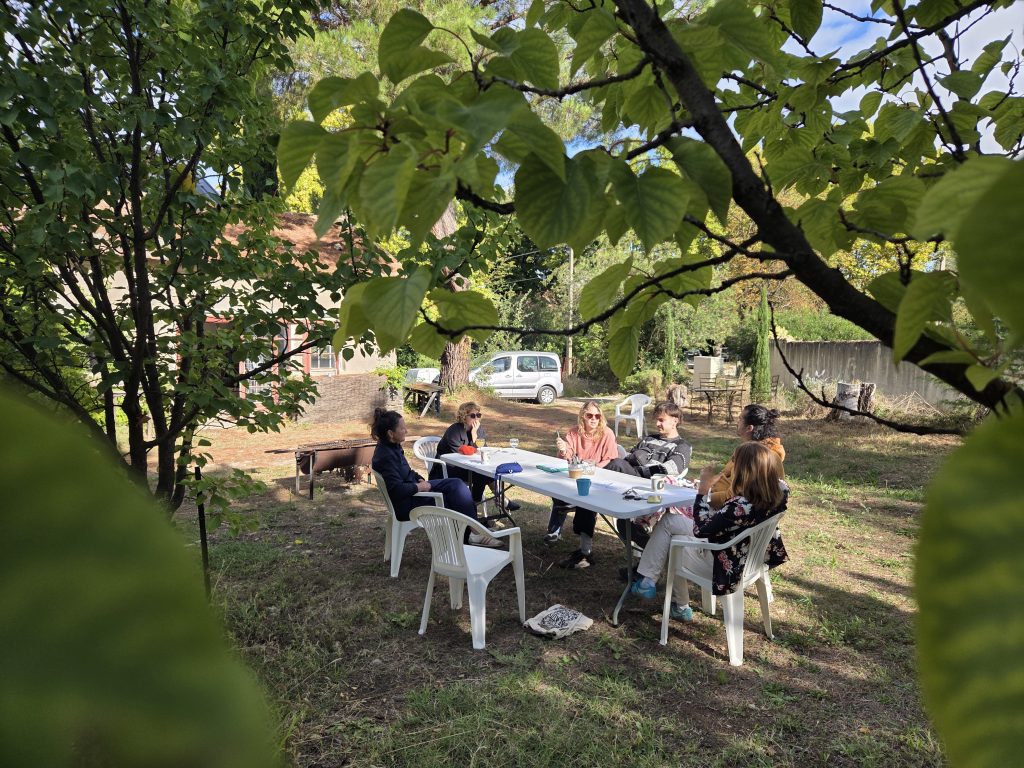
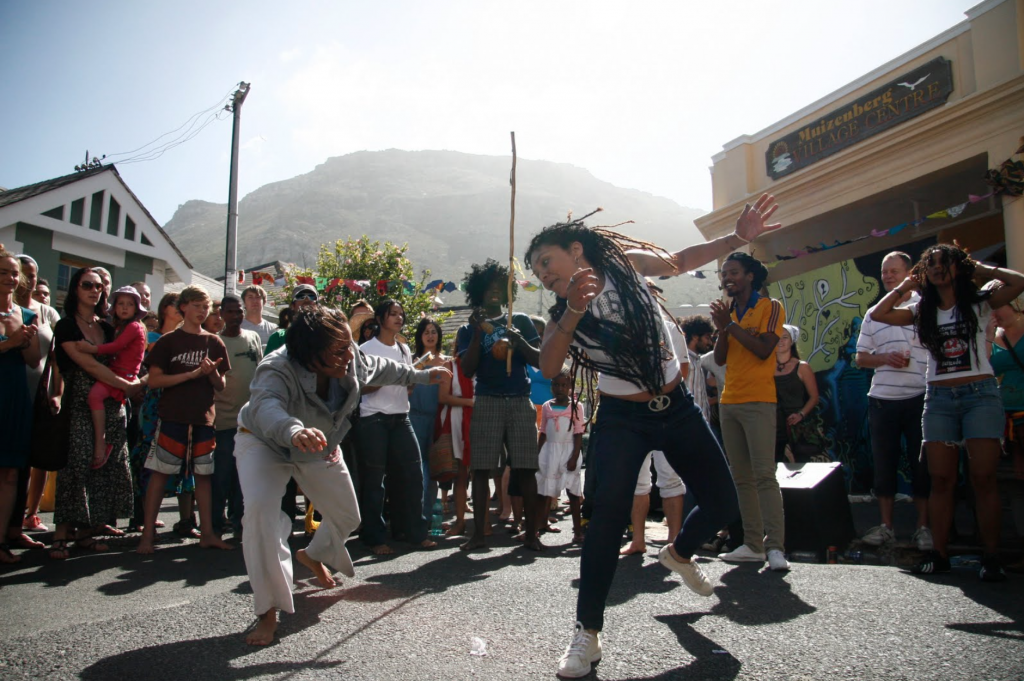
Ingredients for a Festival, South France
For many years I was part of a collective of positively charged, enthusiastic, community collaborators in Muizenberg who connected over the idea that ‘Festival’ was an amazing method to facilitate connection, relationship building and resilience within our community of Muizenberg.
Between 2009 and 2010 we hosted 4 street festivals with the themes of ‘CREATIVITY, COMMUNITY & ECO-AWARENESS’. Our approach was to facilitate a platform where all community members were invited to use the opportunity of the festival to showcase their talents, bring awareness to their organisation or punt a cause. We had no funding so everything was grown according to resources, skills and networks we had access to. Our aim was to do what we could do with what we had and who we were. And we achieved beautiful, heart-centered, colourful and successful festivals!
The festivals grew when we caught the wave of Cape Town World Design Capital in 2014 and continued with another few years of festival. When COVID struck in 2020 our community game shifted and it was very interesting to see who showed up in strong community response: the network of community members that had been built through the festival network.
It’s now been a number of years since we hosted festivals and so the opportunity to be part of the SEEDS4youth Multiplier festival in France was really an exciting opportunity – both to witness and be involved in its organisation.
It was interesting to observe how invites had gone out: posters pasted up around villages rather than relying on social media/ web based networks. Networks between community based organisations here seem to have an excellent ability to collaborate and back up each other, not feeling the need to compete.
Organisation felt quite informal and down to earth. We set up tables, a stage, painted signs, tidied up and co-created a Silent Lab. There was a wonderful buzz as guests began arriving, even though it was windy the weather was pleasant. People were welcomed with pancakes and lemonade as mostly young families arrived first. Games, Parkour, children’s theatre and puppet making kept everyone busy and interacting. A blacksmith set up an interactive activity to get the feel for bending metal and the first silent labs were set into action.
People kept arriving and we realised that our festival was definitely a popular event for the day. Curious community members were greeted by a gracious Milena at the welcome table and wound their way through games, activities and snacks. There was lots of engagement with our ‘talking plants’ and our pop up exhibition which showcased the 4 x graphic harvests and profiled each of our project teams: Italy, South Africa, Germany & France. People asked questions and contacts/ networks were made and built.
As we reached the evening people didn’t stop arriving – we estimated about 400 people attended the event. Supper was served and the choir Afrocoeur assembled the crowd with some awesome Afro infused harmonies. Kids started having meltdowns from tiredness and the families withdrew as more people arrived. Time for the band: Manga Rosa – a high energy live music performance that got people moving.
The final act of the night was DJ Kbira: an explosive female DJay who really stirred the party with her beats and kept the energy up until the early hours.
It was hard to have conversations with people in French but for sure it was a very successful event and I’m sure will have a far-reaching impact of generating new ideas for further gatherings as well as strengthening the connections between organisations and community networks. I felt privileged to be part of it and definitely inspired and motivated to spark something again on the Muizenberg side.
Claire Homewood, Amava Oluntu, South Africa
This is only the Beginning
What began as a project with a clear timeline has transformed into something far more enduring: a network of people and practices that continue to move toward each other, even after the official work is done. If SEEDS taught us anything, it’s that collaboration becomes most powerful when it grows beyond a framework — when it becomes a shared rhythm, a way of working, a way of imagining futures together.
Looking ahead, the strongest currents of this ongoing journey flow toward two partners who have reshaped how many of us understand community impact: Amava Oluntu in South Africa and L’Engrainé in France. Though their contexts couldn’t be more different — one rooted in coastal urban communities, the other in rural landscapes woven with orchards, kitchens, and centuries of tradition — their practices meet beautifully in a common space: storytelling, collective work, and regeneration of places and people.
What we experienced with them wasn’t simply learning; it was an invitation.
From Amava Oluntu, we learned how stories can become bridges in communities fractured by inequality, and how nature, movement, and embodied practice can rebuild belonging. From L’Engrainé, we learned how food, festivals, local roots, and creative story telling methods help revive rural spaces and create cross-generational, cross-cultural connection. And between both partners, a shared truth emerged clearly: community impact is not created for people — it is created with them.
This is why our collaborations won’t end with SEEDS. They will continue wherever stories travel, wherever collective action regenerates spaces, and wherever people choose to step into shared ownership:
- In future exchanges where Forum Theatre, Kamishibai, and body-based storytelling meet South African listening practices, outdoor learning, and silent-lab methods.
- In projects where rural and urban communities inspire each other to reclaim public space, care for land, and build structures where young people lead.
- In creative labs where sound, food, movement, and art become tools for connection across languages, identities, and histories.
- In new festivals, workshops, and cross-border residencies where our methods blend, evolve, and spark ideas none of us could have created alone.
Because the real impact of SEEDS isn’t in what was completed — it is in what it set in motion: a long-term, transcontinental commitment to regeneration, community building, and storytelling as a tool for social cohesion.
And so, standing at the end of one project, we’re already at the threshold of the next.
The relationships are alive, the ideas are growing, and the groundwork is laid.
This is only the beginning.
Sarah Pint, Starkmacher e.V., Germany
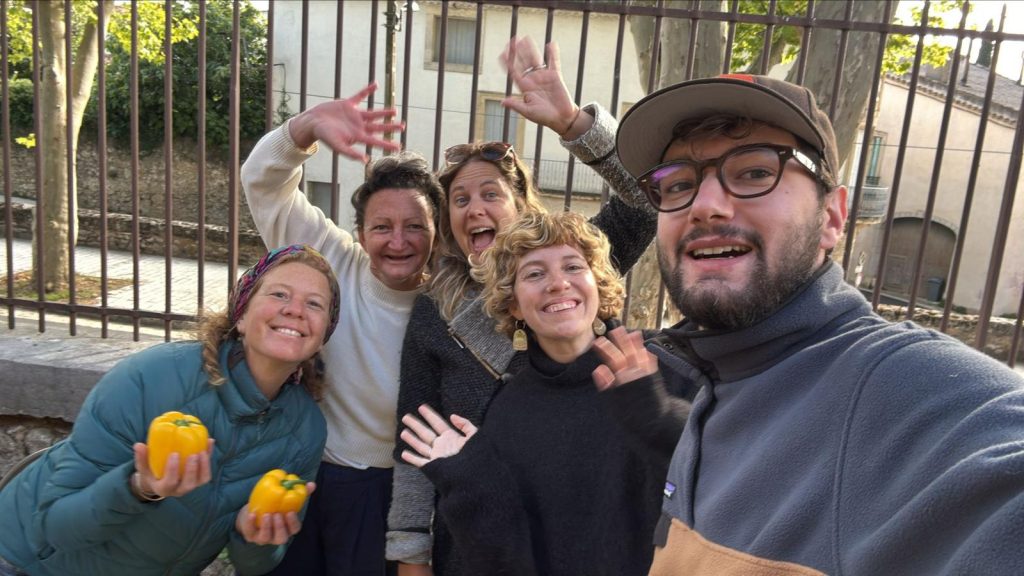
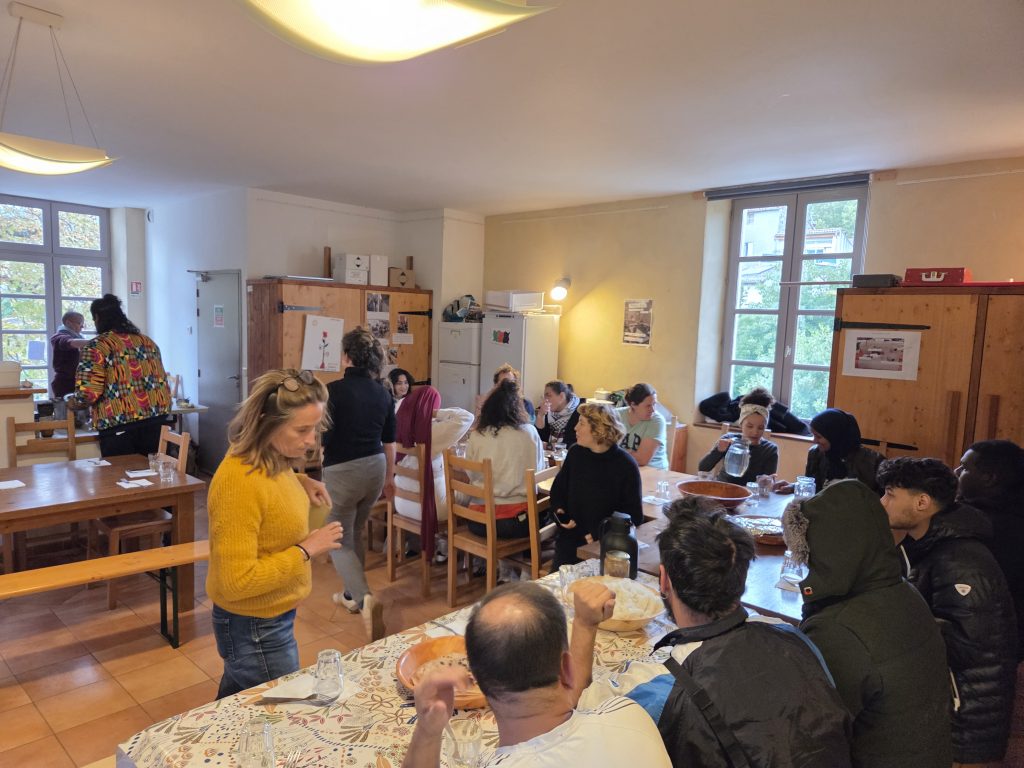
Fields of Possibilities
On Wednesday, September 24, we organised a workshop with the association called „the field of possibilities“. The purpose of this organisation is to welcome and help migrants, or anyone who feels outside society. It helps to create solidarity between the inhabitants of Lodeve and the newcomers. Most of them arrive from a long journey, some crossing Africa, others arriving from Eastern Europe, and are in the process of requesting asylum in France. Meanwhile, they live in Lodeve, and some of them have obtained their residence permit.
In the first place, with some of the seeds, we decided on the menu that we wanted to prepare and cook with the people who were about to come. But the problem is that we did not know exactly how many people would really come. That was the first difficulty; guess how many menus we have to cook.
On D-Day, we arrived in the room; there were two French volunteers & 2 women who spoke neither English nor French. The second difficulty was cooking without the possibility of communication through language. It is such an experience to do an activity without this kind of communication – guessing, showing, smiling – but using words.
During the afternoon, more than 15 people arrived to cook with us. That was full of colours, of smiles, and of incredible experiences.
When dinner was ready and served, everyone showed up with their name and nationality. It was unforgettable, the number of nationalities represented in this room. I felt really happy to be there and to be a part of this experience. Many guests cannot afford this kind of meal, and to share a 3-course dinner with them was nothing else but joy. It was a wonderful evening, full of gratitude. What a show of solidarity!
To be fair, one of the guests just turned 31 during the evening, and the cake was surrounded by candles. When she discovered she really could blow, ‚That was for her,‘ she shouted as if a goal was shouted. She was terribly happy, from deep down. The scene was kind of justice regarding what she passed through during her life. To me, it was a whole new world. I mean, I live exactly 1 min walk from the local we went to, and I have never participated in this event before, and for me it was a huge thing.
I will try to join them, or at least share the next cooking session.
Marion Aube, L’Engrainé, France
Community Building: Context Amava Oluntu/ Muizenberg SA
We come out of a recent past where inequality ran along colour lines. Race granted access to opportunities – achieve and gain, or struggle and suffer. All the years after apartheid was declared deceased and we still fall in its shadow.
Apartheid’s clever engineering made sure that division remains as economics and spatial planning celebrate privilege’s triumph. No matter where you find yourself between these lines, life always requires effort: have what you need, keep up with it, provide for those who need you and enjoy it as it goes quick. Maybe we get wrapped up in some of those so deeply that we forget to look sideways and notice the brothers and sisters in our community or outside of it who may be experiencing a very different lived experience from us. What we could take for granted like accessing wifi to fill in an online form or consuming the necessary nutrition in order to do a day, not being able to stay out after dark for fear of the alley home. Different kind of challenges that trip up even the most dedicated and inspired young person who seeks the road to changing their situation. It takes a bit of stepping outside of ourselves to notice these things, to leave a rope ladder out so that others can cross with it and make it to the meeting. Extending the timeframe, offering a place to boil a kettle and find toilet paper in a safe bathroom.
Amava Oluntu meaning….. the wisdom of people learned over time, honors the idea that every person has a unique offering to bring to the table and should be encouraged and allowed to do so. Hold the space and people will come. Amava’s projects have grown out of many years of individual nurturings of community projects. Platforms created by inspiration to weave and relationship build, to stir individual passion into action and action into impact. The joy of being involved and sharing your shine with however your abilities have been sculpted. The strength in diverse community finds its metaphor in our fynbos, the natural flora of the Cape, floral kingdom of the world. We remember that we are stronger when we step into the circle with our differences acknowledged.
In Cape Town we can’t help but be in awe of Nature. We won’t, however if we don’t know we can access it. Community building happens in relation to nature. We are nature and without it we fall off the planet. With a strong sense of our base in nature we engage in collaboration as does the weave of the natural world. The deeper our sense of connection the wider our connection to what’s possible and, the more precise our impact.
Creativity encourages going beyond what reality seems at present. The ability to imagine more, imagining something that steps up toward potential. A way to bring it closer quickly is working together and through relationship building and speaking across the lines of division, we weave. We weave and weave until our imaginings become knitted into thick reality and they drop down into actual change. The more opportunities we have to meet each other, meet the teachers, the growers, the thinkers, the makers, the law makers, the rule keepers, the rural, the urban, the man, the woman, the young … the denser our weave and the more potential to drop into seeds.
And sometimes the form of the weave we made has to die, dissolving to make some space to see how the seeds might sow in their own way. Patience, practice and slow and committed nurture of the clues that keep reminding us of the future that’s right for us. And little bit, by big bit new potentials can sprout. Made real in a way that we could never have anticipated: the brilliance of when many come together go beyond what any individual could have achieved alone.
Community action activating change because of the mycelium networks built over time in creativity, nature and celebration. Practising the organisational skills needed as we go, getting to know each other’s strengths, seeing who is there and being ready to make change happen. Not forgetting how important it is to make it fun.
It was snippets of this that we wanted to share with our SEEDS4youth learning exchange…. what we have built, how have we done it, based in our grounded African context: not with theories and texts but with smiles, human connection, intuitive hearts and messy creatively collaborative hands.
Claire Homewood, Amava Oluntu, South Africa
