Impact Stories: Conditions for Participation
Flexibility, Adjustment and eye-to-eye level
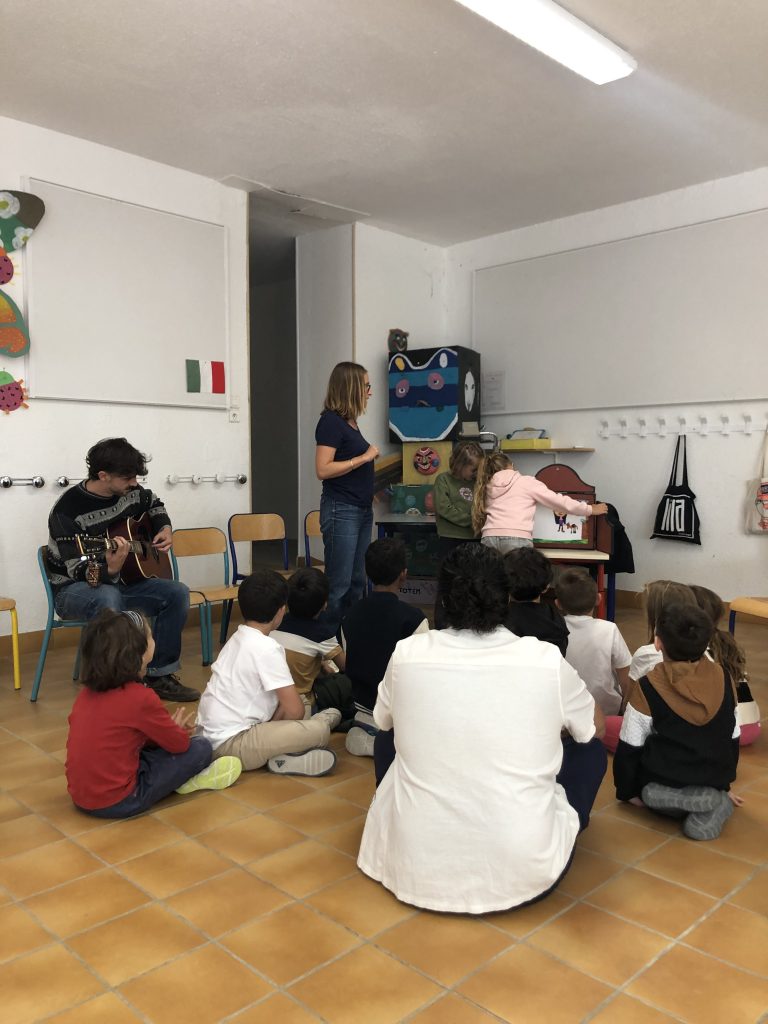
I find myself in a classroom full of curious children, 4th grade as I remember. I don’t understand a word in French but from what I understand in reading bodies and faces, there is an exciting exchange happening. Milena, the facilitator of the Kamichibai-Workshop, is sitting on an eye-to-eye level with the children and guides the entire room smoothly through the plan of the day.
What the children don’t know: we had several detours on the way to the school and there was still one crew member missing for the story that was about to be told and played. Milena went along and while she was in the process of introducing us to the kids, she simultaneously adjusted the program to the circumstances, in a calm and humorous way.
My first take away in this experience is: stay flexible and go on. Most things in life don’t exactly go as planned, adjustments and flexibility are very important attitudes and practices, especially in social and educational work-settings with many human-to-human interactions.
The second take away from this experience is Milena’s way of approaching the children. Throughout the workshop she physically moved on the same level as the children, and when she was interacting with them, she seemed to approach every single one of them in a direct way. It moved me to see the way that Milena was talking to the children and how she opened up the process for wild imagination and brainstorming and how she managed to shape these images into a nice form of a story. She also approached the quieter children, therefore it was made sure that no child was left unheard.
All in all, the participatory workshop and its outcome was very impressive. The Kamishibai-Workshop was a great experience in terms of collaborative work among adults and children, where adults create a frame but the children decide what is being said and told. Children’s voices are often unheard or not considered in political debates and decision making. The Workshop is an example of how story telling can work as a great tool to make unheard voices heard. Democracy means participation, and Storytelling is an empowering method that we experienced as a great example of implementation.
Jule Reicherter, Starkmacher e.V., Germany
Chocolate, Poetry & Beats – A local youth activity
On the evening of April 15th, 2025, the Commons Studio in Muizenberg was transformed into a sanctuary of flavor, expression, and connection during our Chocolate, Poetry & Beats—a journey that left hearts full and taste buds awakened by nutritional cacao.
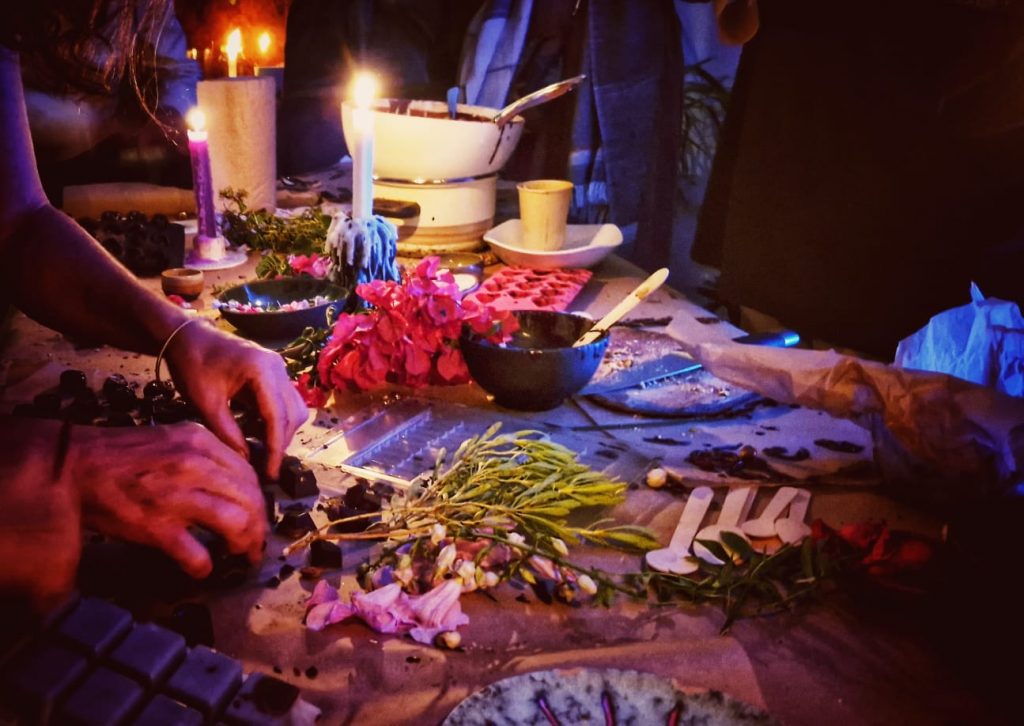
We worked hard to create a welcoming space beginning with a ceramic bowl for washing hands. Next we had prepared words in typewriter font printed onto sticky paper. Guests could choose 2 or 3 words (like fridge poetry) and stick them onto a peg which became their name tag. This gave everyone a unique alter ego (chocolate inspired) for the evening. Our main intention was to focus on the way ‘Food can Gather’ and weave people together.
Then, there was our welcome drink: a very special drinking chocolate, rich in nutritional depths. We prepared little pots of additions such as cinnamon, ginger, cayenne or salt as a dash to suit different tastes. This drink was intended to provide an ice breaker moment and allow the magic of cacao to begin opening hearts.
The ice was broken and people began to mingle….
I was the hostess so I gathered everyone around the long work table which we had set up to be laden with everything we needed for the chocolate making. First I asked everyone to introduce themselves with their chocolate name. This brought everyone into the circle. Then I explained about the different forms of raw cacao: the bean, the paste, the butter and the powder. There was a bit of each in little bowls so as I explained and introduced them we passed them around so people could smell and taste – it’s surprising. I explained the main process and the further ingredients we needed: coconut nectar, vanilla and salt. Some had never seen a vanilla pod or knew that it grew on a tree. We chatted about how chocolate, when kept in its raw state, has many health benefits
The melting and the making – the slow melt over the double boiler gave everyone more time to chat and help themselves to soup. One cannot be hungry when making chocolate as it’s a powerful substance, so best to fill up first. The soup was made from seasonal ingredients and spiced with a cape curry flavour – topped with extra nutritional toasted seeds.
The stirring began as the cacao butter melted – from creamy white to clear, fragrant chocolate filled the air. When completely liquid we added vanilla and cacao powder to taste, the flavours filled out and then added sweetness and salt. Our thick chocolate appeared and we taste tested until perfection. The air was now electric with anticipation for chocolate play.
All kinds of moulds appeared and chit chats continued as we polished them up… ready for pouring. Everyone was invited to creatively concoct sculptures of chocolate and mixed in extras – spices, nuts, seeds, dried fruits etc…. The music that our ChocolateDJj played provided extra encouragement and as we prepared molds for setting, the buzz that the cacao had stirred now flowed into poetry and the typewriter was alive with words and inspirations.
Cracked out and the joy of seeing chocolate in sculptural solid form fluttered through our group. Each was invited to make up a little package, adding flowers and stringing together the poetry pieces and postcards for the perfect takeaway.
What I loved the most was the diversity of people and how there was such a warm, creative and chocolatey atmosphere for appreciation. Simple coming together and enjoyment of each other and love of chocolate with new depths. Chocolate, Poetry & Beats proved that magic happens when we gather with intention, open our senses, and allow creativity to flow freely. It was a night to remember—and a beautiful reminder that community, like chocolate, is best when shared.
Claire Homewood, Amava Oluntu, South Africa
Digital Culture
The mobility in Germany and the organization of the stay in France have led us to open new
perspectives when it comes to digital creation.
We had the opportunity to welcome a woman from the library network with whom I had the
pleasure of developing several projects. In the context of mobility, she presented us with a method for creating sound content and making objects talk.
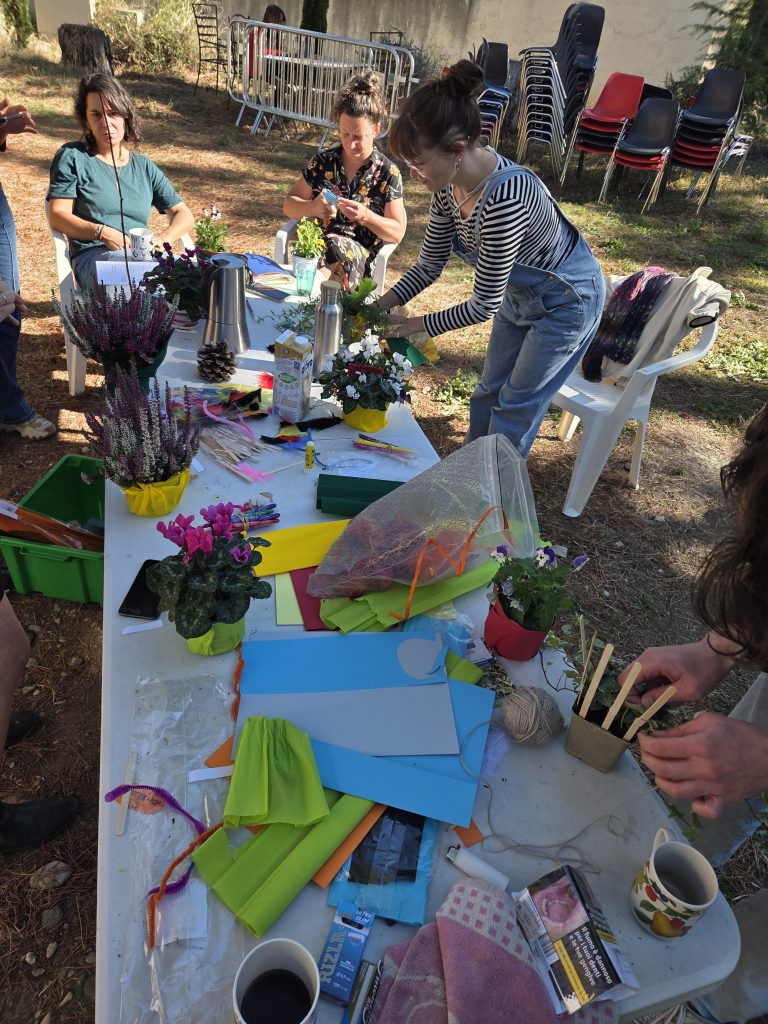
For our activity that lasted only 2 hours we took advantage of this technique and experimented in a very basic way with the tool. Each participant chose a plant that he assigned himself to, then recorded a short text on the Seeds4youth project. The idea was to understand the mechanism in order to develop it on a larger scale afterwards. We used our talking plants for the final exhibition
of the project.
This initiation made me want to develop digital artistic creations. Last year we produced an interactive digital book in which you are the hero with the teenagers of the surrounding villages.
This creation took place over 6 months and involved painting, writing, photography, and sound recording. We had then organized a big restitution day to access the book. We then recorded poetic texts set to music by the inhabitants, which we made freely accessible through QR codes in the village and in nature.
The fact of speaking about objects can give continuity to these beginnings of digital creations by allowing staging of written texts and life stories. I don’t know yet under which bias but the fact of apprehending the activity of plants that speak opened me to these creative perspectives. In Mannheim already, the discovery of the Silent Lab had given me the desire to collaborate around this tool and create educational workshops with this support.
I don’t know yet how and what form but the next activities developed will use these new tools for an educational, creative and social purpose. We hope that our new European and South African partners will be on board to build collective projects with the acquired tools.
Milena Lachmanowits, L’Engrainé, France
Artists as Builders of Social Cohesion
Our French mobility moved me in ways that I never expected. I thought I would learn about theatre, and nature connection and artisanal land and food practices and cooperatives, and that we did, but I what astounded me was the strength of the social cohesion and how participation and collaboration are embedded so deeply in people that they are largely unaware that there is anything remarkable about it.
So many of us have to work so hard, just to get to that starting point, before we can even begin to create anything. Creating upon a foundation where everyone intrinsically understands and values the act of collaboration was such a pleasure, and reaffirmed the unending hard work to get to this way of interacting back home.
I thought about this a lot throughout our time in France, in an attempt to understand how to achieve this. As usual I think that there are layers and layers of factors, some light and some dark, which each deserve a story of their own.
A huge contributor, is having all of one’s basic needs met. When large amounts of your daily energy are consumed with survival, there is not a lot left to do anything else with. When your every day reality feels like there is not enough resource to go around, or when enough is never enough, many resort to competition rather than collaboration.
Social cohesion within and between communities eradicates a whole host of problems that no amount of government spending will ever be able to eradicate. Witnessing the effect that institutionalised support that both ensures basic needs are met, and supports artists and associations to create and connect, certainly made me wonder out loud why this is not standard practice the world over.
Theresa Wigley, Amava Oluntu, South Africa
Welcome and expression
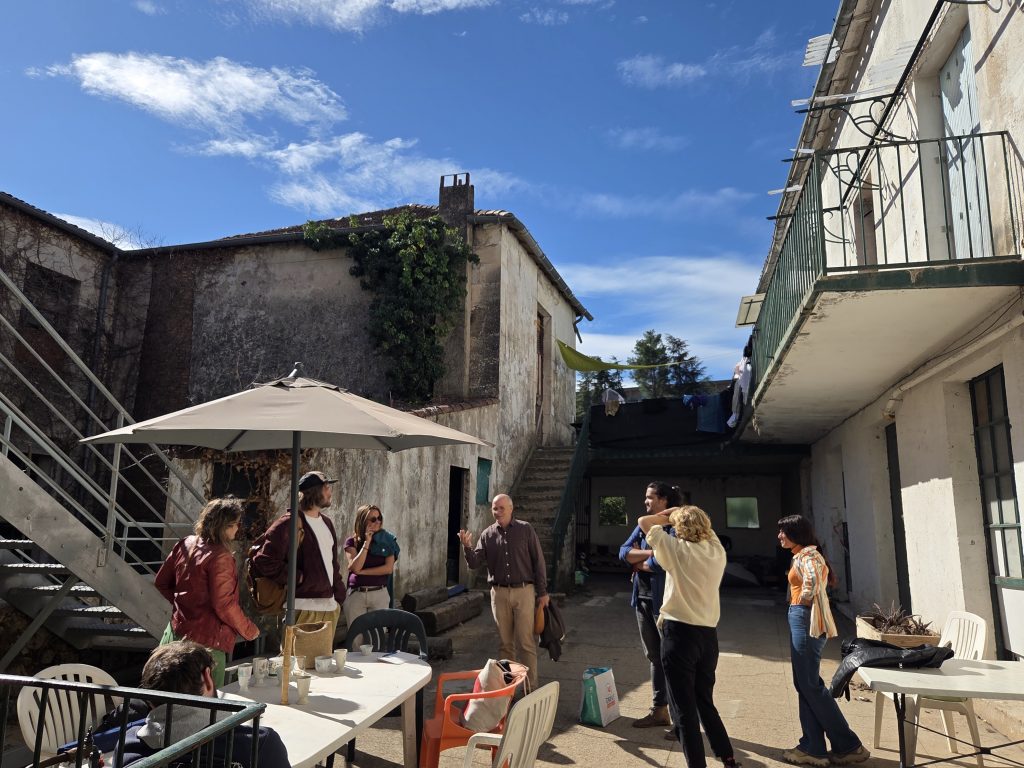
On May 16, we held a workshop on gender equality in the social and solidarity economy. I disagreed with the facilitator on the substance of his presentation, and what seemed most important to me was being able to express it. Why do spaces allow for more or less expression? I think it’s the way of welcoming and introducing oneself. I recognized a way of welcoming and introducing oneself to the group that was essentially identical to my own, despite cultural differences. Could there be something universal in the way of allowing people to feel good in a group? A way of welcoming that allows people to listen, to participate, but also to express their disagreements without endangering the group.
Things that might seem like common sense are absolutely not practiced in all the workshops or meetings I have attended in my life. Drinks and a little food are available. A possibility to move around the space, to sit as we please and wherever we please in the room, to be comfortable in our bodies. Doesn’t this allow us to be truly available to what is happening, to feel good in our bodies? Why can’t we take off our shoes or sit on the carpet in all meetings? What does this call into question, what would it confront?
Also, the way of introducing oneself: the facilitator introduces themselves, and invites the participants to do the same. This, again, may seem like common sense, but not everyone does it, which sets up dynamics, either collective or vertical, which do not allow one to feel equal with the facilitators to express any disagreements.
Laurelou Pelletier, L’Engrainé, France