Impact Stories: Where People Meet and Methods Grow
South Africa Hosting
We did our planning during the end of the winter months – the wettest winter in Cape Town since 1967. Spring and the arrival of our SEEDS4youth guests was a welcome blessing to us and a much anticipated sharing.
The hosting gave us an opportunity to weave together our projects, collaborators, sights, sounds and culture all into a very full SA programme. We spent many weeks with post-its and large rolls of paper mapping out all we wanted to do, editing it down to what we could actually do in the timeframe. What was important for us was giving a sense of the wild nature connection we have here – the role that nature plays for us is very important and filters into our work in many ways. An understanding of the history of this place was also vital and so we needed to make sure we gave a sense of that both through the places we visited and the conversations we had. Of course we needed to also give an experience of the variety of tastes that our multicultural home offers so we added in multiple eating adventures and flavours.
There were many highlights: seeing everyones appreciation for the opportunity to be in South Africa, feel the sun on their faces and the fresh sea air – I loved that moment where people really connected to the land and felt what that is…. Something you can’t explain but has to be experienced.
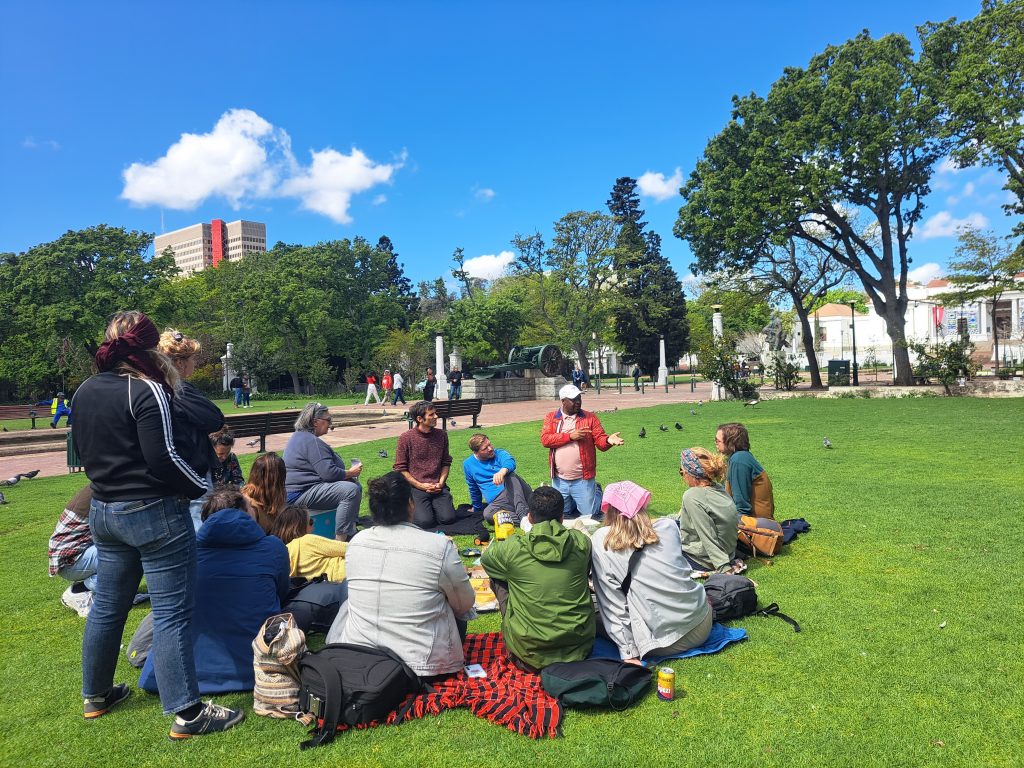
Here we practice a lot of circle speaking, listening to each other and making sure to give all voices a chance to express themselves. We definitely did a lot of sitting in circles. Our Food Jam worked amazingly at bringing everyone together in a fun cooking experience of teamwork, experimentation, dance and celebration.
Our visit to Vrygrond affected everyone deeply. To see people living in poverty, walk amongst our fellow humans living in such a reality and still be greeted with smiles. It’s hard to really see what the affluent world is built on and how real the struggle is for some. This day also gave our European colleagues in this project more understanding of what and who we are working with when we talk about ‘youth’ in our context. The art process at Butterfly Arts helped everyone to digest the experience and was also encouraging and hopeful to see an organization making such a huge difference in the Vrygrond community.
Challenges were mostly within our own SA team. The dynamics between partners and how to work together. It was a time of change for our local projects and the hosting brought our energy and focus to see what is and isn’t working, what needs to shift and what needs completing. This was a blessing in the bigger scheme of things. We were quite honest with everyone about these challenges and changes because as parallel organisations we can really learn from each other when we share the realities and truths.
Personally I loved having everyone here. I love doing the thinking beforehand into what was and wasn’t important to include in our programme. To reach out to our network and see how we could collaborate to bring things together. I enjoyed my role as coordinator even though there were some hairy daily moments of managing logistics, changing plans, balancing multiple individual needs and still keeping in mind what was needed for tomorrow/ next week, etc etc. It was full on and fast paced but amazing and I would definitely be up for more hosting. We have a real magic here. In our diversity, inbetween the harsh realities, amongst the many sites of awe inspiring nature… there is a connection to the heartbeat of life which is a resource that is bountiful and one which is a pleasure to share with those interested in experiencing it and taking that expanded knowledge and understanding home with them.
Claire Homewood, Amava Oluntu, South Africa
Community
In Mannheim, we met the community development manager for the Neckarstadt district, which is very multicultural. She works for the city and is responsible for improving the quality of life in her reference area, based on the needs of all its residents, regardless of their identity or situation. What struck me was the similarity of her job as a territorial manager with what I experienced when I worked in Quebec. Indeed, accepting the notion of „community“ is central to local urban social development. Building a community means creating connections in a given area to improve the quality of life there. Building a community means acting together to actively transform our living space. And this community is a grouping of the many that compose it. Different communities that exist depending on people’s situations and identities. The territorial manager spoke to us about the community of sex workers in the red-light district, for example, about ethnic communities, and about collective associations mobilized around participatory vegetable gardens, for example. In these cases too, the idea of community is to act together, between people concerned, to improve specific living conditions.
This was significant for me because in France, the idea of community is very poorly perceived. As if self-interest were an affront to living together. As if mobilizing to defend one’s specific living conditions necessarily represented a democratic counter-power and called into question both republican unity and the universality of law.
Following this meeting in Mannheim, I believe even more strongly that uniting within a territory to defend its specific needs means participating in a society and a state that adapts to meet social needs and fosters democracy.
„A society is democratic if it recognizes itself as divided, that is to say, as being crossed by contradictions of interest, and which sets itself the task of associating each citizen equally in the expression, analysis, deliberation and arbitration of these contradictions.“ Paul Ricoeur, in Ideology and Utopia, 1997.
Laurelou Pelletier, L’Engrainé, France
Context Analysis
Studying the context is essential.
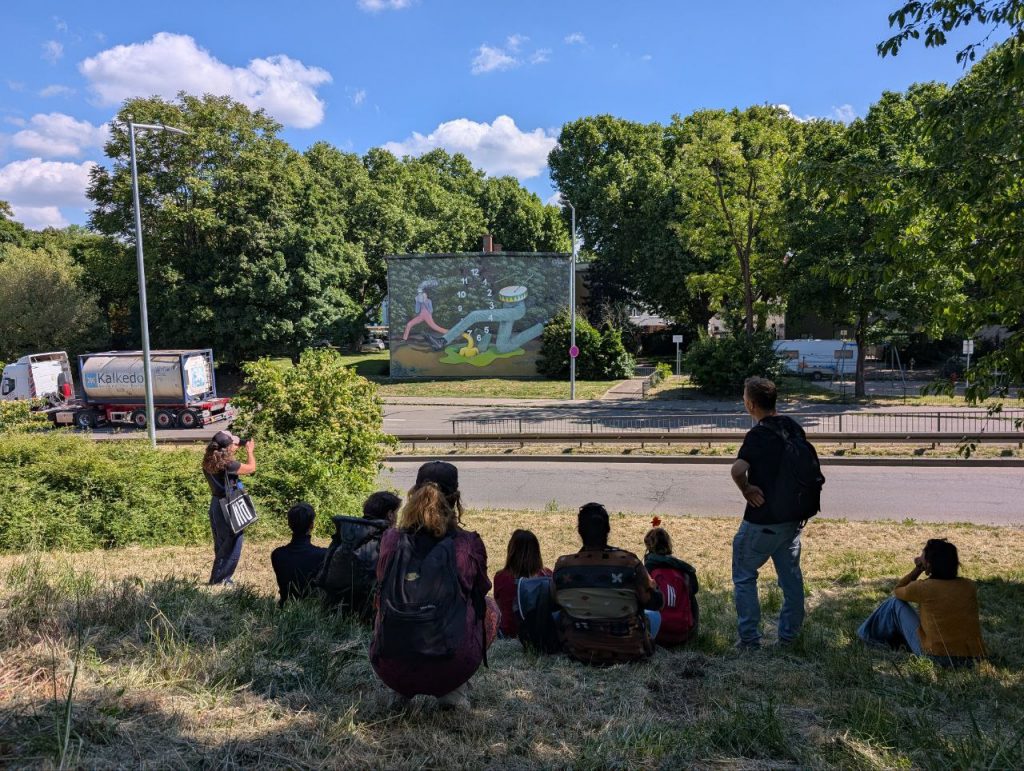
Asking ourselves where we are, what defines the spaces we move through, and who populates them is the first step toward understanding.
In Mannheim, the urge to question every passerby was strong. In people’s eyes, I could see long roads walked and small habits formed, day after day, in this diverse and welcoming city.
Analyzing a context while being immersed in it can be complex, stimulating, and at times disorienting. That’s why we look for frames — reference boxes that help us define boundaries, only to later challenge and go beyond them.
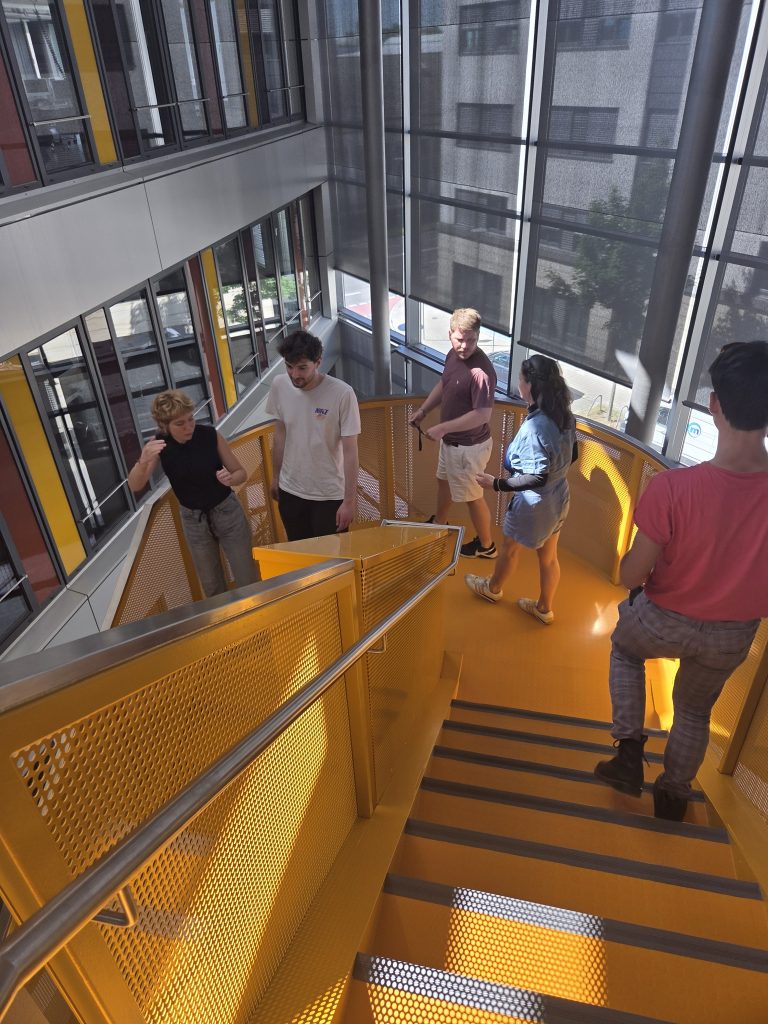
At the TUMO Center in Mannheim, I discovered the evolution of a hands-on, future-oriented initiative. A place where young people explore digitalization through both artistic and scientific lenses, supported by cutting-edge equipment and carefully designed spaces.
The concept originates in Armenia, where the TUMO model was born, bringing with it detailed know-how and methodological guidelines. In Mannheim, it is led by Starkmacher with strong support from public institutions. And yet, each day presents a new challenge: reaching and engaging young people, staying faithful to the original vision while adapting it to a new, specific context.
It’s an ongoing process of analysis — and this is what makes the impact both dynamic and lasting.
Because analysis is not just a starting point — it is a practice that helps us constantly uncover new layers, new voices, and new sparks of light.
Ivana Ristovska, Eufemia, Italy
Cooking Workshop
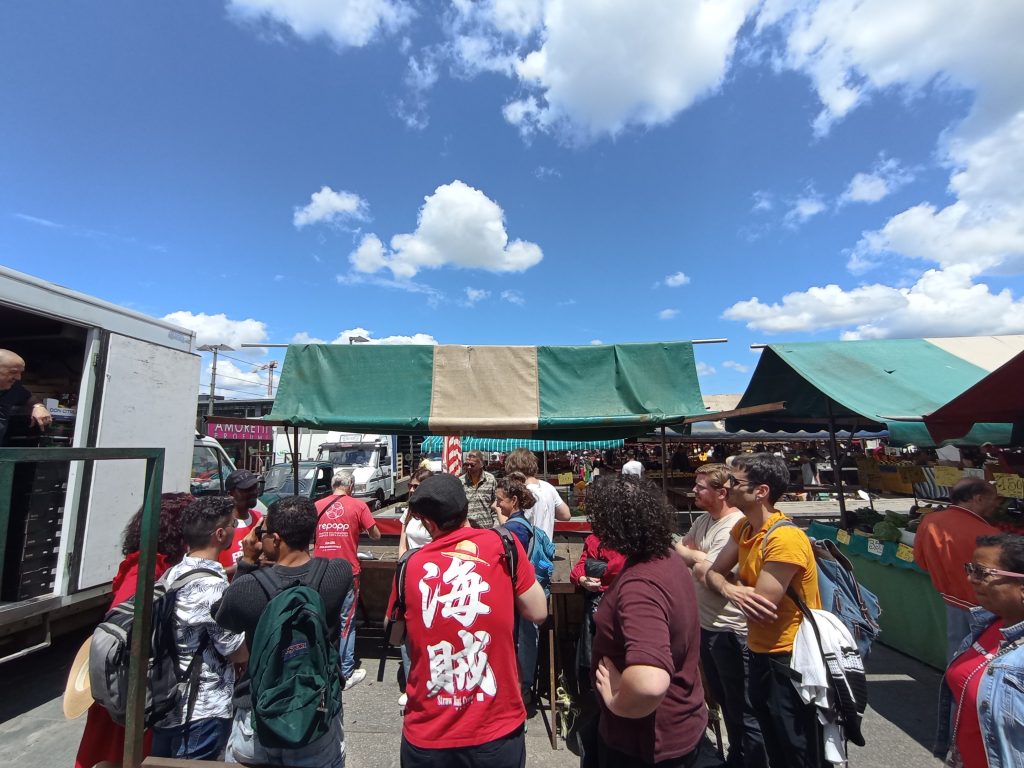
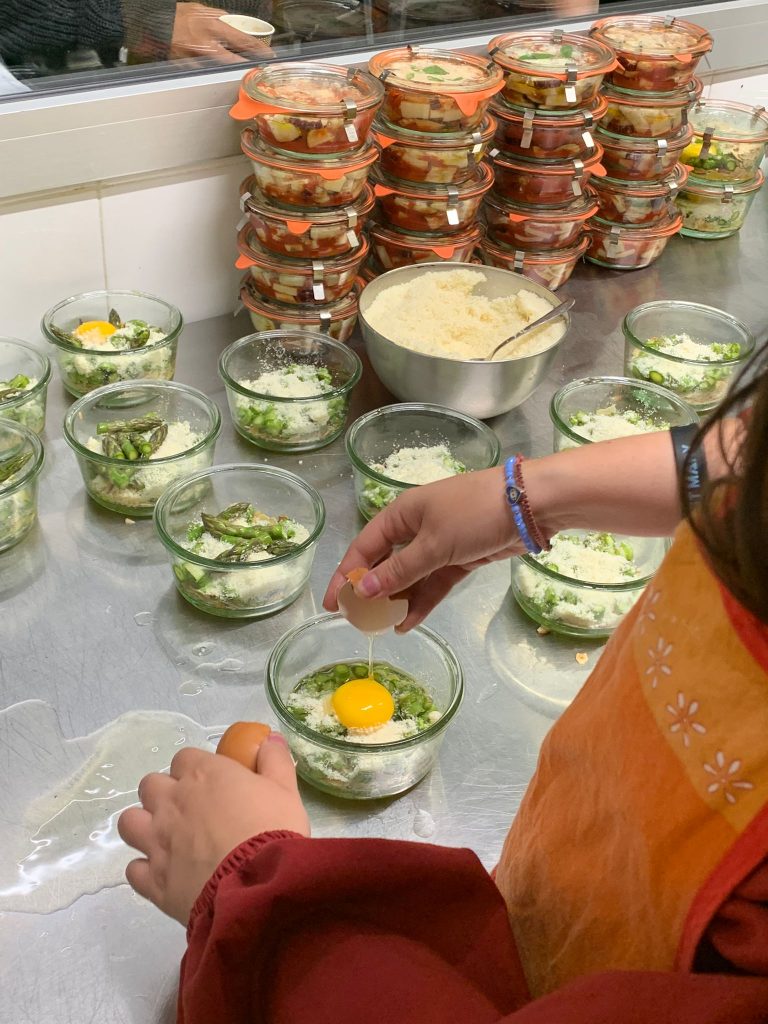
In Turin, we discovered collective cooking workshops. The association Il Gusto del mundo
organizes shared cooking sessions with diverse audiences. We collaborated with a group that included people with mental health issues, international volunteers, and our Seeds 4 Youth team.
The group was supervised and supported by Paola, Stefano, and Flavio.
One of the workshops that spoke to me began with a roundtable discussion about „what do you put on your pizza?“
Each person suggested their favorite pizza, and together we went shopping for the workshop. The following hours were spent making pizzas in a professional kitchen, as well as preparing desserts.
The goal is to cook and then eat together. This is a vector for integration (people are often in
situations of social exclusion), cohesion, and social connection. Cooking then becomes a medium for sharing, discussion, and the creation of a safe space.
In France, with L’Engrainé, we currently do little work on using gastronomy as an educational tool. The experience we had at Il gusto del mondo gave us the desire to create connections to address this.
In September, we will be working with an association called Le champ des possibles, which uses cooking with people in migration situations. We will cook together in the afternoon around a theme and then we will organize a shared meal in a festive atmosphere in the evening!
Milena Lachmanowits, L’Engrainé, France
Big Game
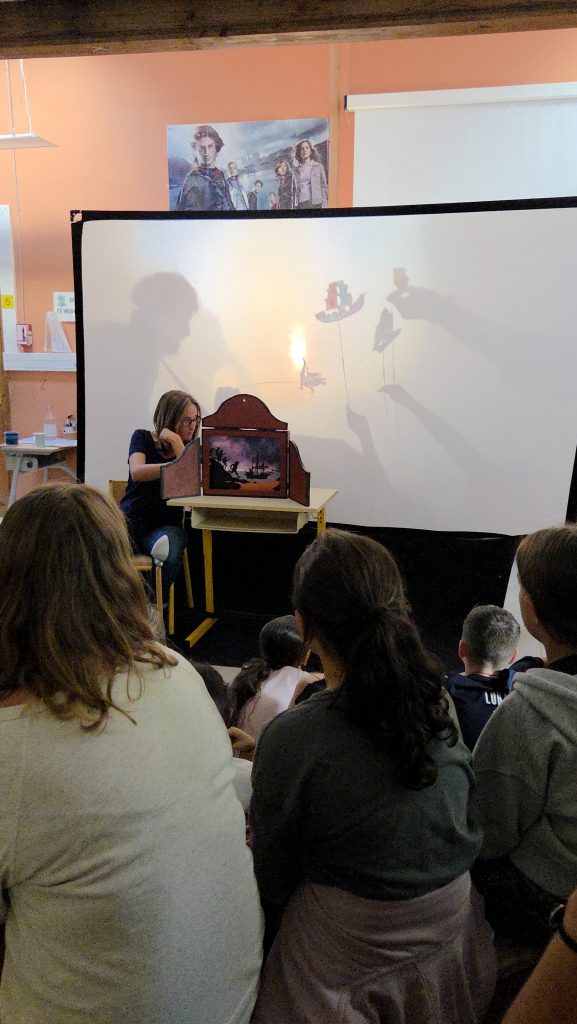
We’re increasingly developing the great game tool during our gatherings. It’s about creating an
atmosphere, a setting, a theme, and playing with it. Participants are assigned roles and must create a space that they will decorate according to the atmosphere they wish to create. Typically, there are six or seven
different spaces and about ten organizers. The audience moves from one location to another to solve a riddle that will end the game.
The idea is to create collaboration: collective development of a riddle, the setting created by the group, and the audience must interact to reach the solution…
Beyond that, the game develops creative skills and gives each member their own role (actor, decorator, mediator). The game’s theme also has an educational value, as the topics covered aim to introduce participants to a specific area. In the case of our stay in Aniane, the idea is to share knowledge about French farming and winemaking traditions.
The game lasts approximately two hours and ends with a large gathering where the teams present their findings to the group. The outcome is collaborative, and no winner is chosen.
During our festival, we would like to introduce this great game in several languages with the help of our foreign partners. In addition to introducing the tool, it will allow our audience to learn from our guests about language, culture, and tradition.
This will also be an opportunity to work on artistic expression, which is one of the key themes of our project.
Milena Lachmanowits, L’Engrainé, France
Seeing home through the perspective of others
The beauty of travelling is that it always changes the idea of “home”, both in the mind of those who arrive and those who welcome them.
For travellers, the destination/stopover is something new, something they did not know before, it is distance, complete immersion in a different and previously unimaginable way of life.
For those who welcome, it is a way to see their everyday life through the eyes of the traveller. Those who welcome others have the pleasure of seeing their city through the eyes of those who do not know it, and this makes everything seem different and gives it a new value. This value can range from the simplest things, such as the aesthetics of the city and the details of the streets that are not usually noticed in everyday life, to one’s own identity, what one does in life, one’s work and the problems one faces.
If we always stay among ourselves, inhabitants of a single place, who can see us? It’s a bit like always staying at home. When we welcome someone, we can finally rethink ourselves and surpass ourselves, we can understand who we are and we can notice the oddities and beauty that surround us in everyday life.
And at the table, for lunch.
For this alone, it is worth meeting, as we have done.
Flavio Vigna, Eufemia, Italy